
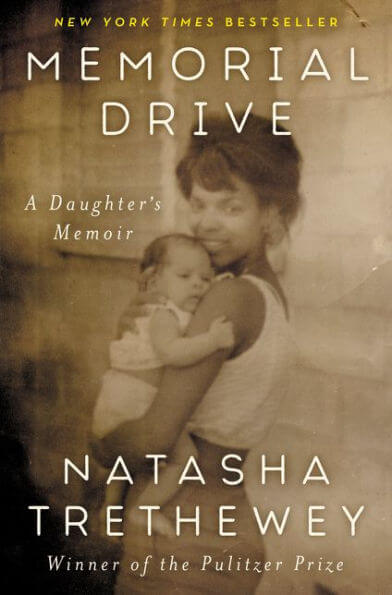
Book Review: Memorial Drive
This post may contain affiliate links. If you purchase through links on my site, I may earn a commission at no cost to you. For more information, please see my disclosure policy.
This is my book review of Memorial Drive by Natasha Trethewey, a Pulitzer Prize winner and former two-term U.S. poet laureate, who has published five volumes of poetry and a work of prose.
Thirty-five years after her mother was murdered, Trethaway wrote this memoir.

She was 19 years old and in college when her former stepfather, Joel, shot and killed her mother, Gwendolyn, who was only 40 years old. They were divorced by then, but he wouldn’t leave her alone.
He was a troubled man, a Vietnam veteran. Her mother died outside of her home in a suburb of Atlanta.
Afterwards, Trethaway remembered being led from a dorm room to the crime scene, where a local news crew filmed her.
Grieving and still new to adulthood, she confronted the twin pulls of life and death in the aftermath of unimaginable trauma. She explores how this experience permanently shaped the artist she became.
Instead of recounting the crime, Trethewey returns to the years leading up to it. She writes about her mother’s history in the deeply segregated South. And through her own girlhood as a “child of miscegenation” in Mississippi.
She knows that trauma shaped her identity, affected her life, and her work.
About the Author:
Years later, Trethaway and her husband were walking in Decatur, Georgia, when a policeman approached them. The officer said he recognized her from long ago. He told her that he’d been first on the scene the morning her mother died.
The man said that the police usually destroy case records after 20 years. And he offered to get them for her before that happened if she wanted them. She realized that she did.
It was within these files that she learned more about her mother’s life. And read her mother’s last words. That was the impetus to write this book.

Trethaway said she knew that she was rendered illegitimate in the eyes of the law because her parents’ inter-racial marriage was then illegal. Her father was a white man, a future academic born in Nova Scotia.
They divorced, and later her mother married a clearly damaged man who abused her.
The murder of Trethewey’s mother followed months of beatings and threats by Joel. Gwendolyn and Natasha escaped to hotels and shelters.
Until there came a time when her mother had the wherewithal to leave him for good.
She moves through her mother’s history in the deeply segregated South and through her own girlhood as a “child of miscegenation” in Mississippi.
Trethewey writes about their lives in the lead-up to the harrowing crime that took place on Memorial Drive in Atlanta in 1985. An event that shaped her and that she finally reckoned with by writing “Memorial Drive.”
My Thoughts:
“Memorial Drive” is an insightful, heart-wrenching book clearly written from the depths of pain. In the memoir, Trethaway was forced to confront her mother’s murder. This book finally addresses it and finds a place for it, so she can move on and live her life.




Writing this book must have been cathartic for her. I can’t imagine going through that at such a young age. What surprises me is that the records are destroyed after 20 years. TV has painted a picture of these types of records being kept in storage forever. I never gave it any thought I guess but I realize that keeping everything would be a storage nightmare.
I think that unsolved homicides can stay open indefinitely. But records on a closed case are kept until all appeals are exhausted, or the defendant dies. Each state probably has a variation of this.
Powerful story! Thank you for sharing, Brenda!