
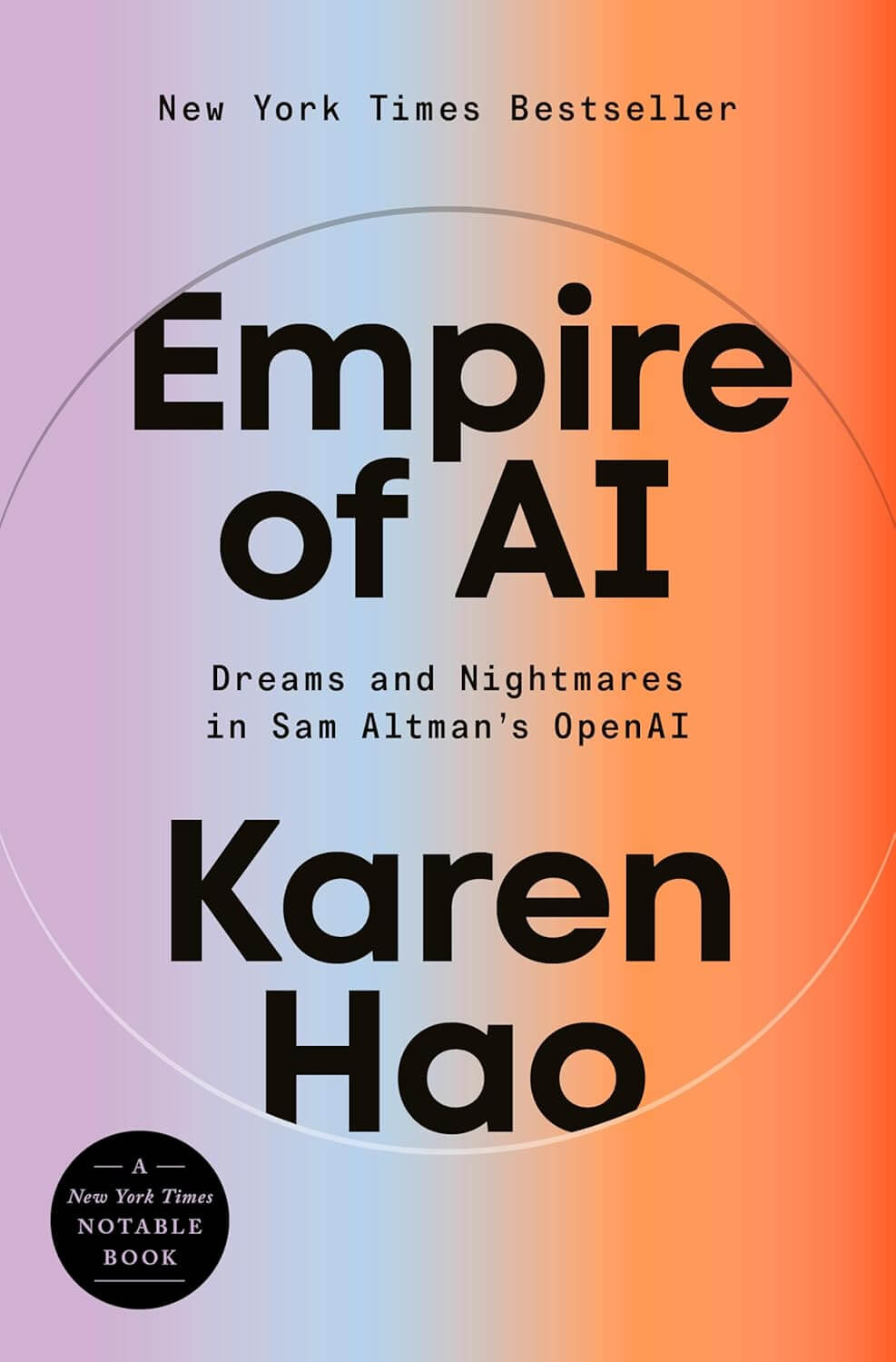
Book Review: Empire of AI
This post may contain affiliate links. If you purchase through links on my site, I may earn a commission at no cost to you. For more information, please see my disclosure policy.
Empire of AI is about the mad dash to propagate AI data centers that produce artificial intelligence, which could only exist by consuming the world’s information.
Author Karen Hou delved into the lives of the big players inside the tech world to bring us a narrative on what happened, how, and why.

OpenAI started out as a non-profit company, but later it was determined that gifts and grants were insufficient to achieve its purpose. Then, a structure was designed to allow private investment, but the new rules are somewhat vague.
Sam Altman, one of the players involved in the enterprise, if not the biggest, seemed almost obsessed. The more time that went by, the less concerned he seemed about safety issues.
There was much debate and defections due to bickering and open rivalry.
The tech giants said that everyone would benefit from their mission. But you can’t discount the vast energy and water resources these data centers consume. And a price will certainly be paid for that usage.
How Will AI Look Decades From Now?
There is much debate about AI (Artificial Intelligence), and much of it is negative. The different factions competing to get their work done the fastest led to many safety concerns being glossed over.
There was much poaching of talent, and scores of workers who were used and paid a tiny pittance. The first models had offensive language that someone had to delve through.
AI data centers primarily use high-quality potable (drinking) water for cooling. This is often sourced from local municipal supplies to prevent contamination and scale buildup in sensitive equipment.
Large data centers can consume up to 5 million gallons per day, equivalent to the water use of a town populated by 10,000 to 50,000 people.
With larger, new AI-focused data centers, water consumption is increasing alongside energy use and carbon emissions. Meanwhile, more and more data centers are cropping up worldwide at an unprecedented scale.
Behind the Scenes Manuevering:
The behind-the-scenes maneuvering between the most talented people in the field sometimes felt like a group of toddlers jostling each other and saying, “Mine! It’s mine!” The competition to complete the goal fastest was fierce.
Hoa wrote: “GPT-3 had now arrived amid unprecedented racial upheaval and hundreds of Black Lives Matter protests breaking out globally, without any resolutions to these issues.
“OpenAI had simply admitted in its research paper describing the model that GPT-3 did indeed entrench stereotypes related to gender, race, and religion, but the measures for mitigating them would have to be the subject of future research.”
Both the positive and negative benefits of artificial intelligence remain unknown as the future unfolds.
Weeding out the Bad Stuff:
Hao wrote: “Tech giants and unicorns were building their extravagant valuations not just with engineers paid six-figure salaries in trendy offices. Essential, too, were workers, often in the Global South, being paid pennies to carefully annotate reams of data.”
The low-paid workers were faced with traumatizing images. Someone had to do the cleanup work, and this information had to be weeded through. Only after ChatGPT’s release would these workers begin to grasp exactly what they had paid for with their peace of mind.
Hao wrote: “The demand for data was growing so vast that companies were scraping whatever they could find on the internet, inadvertently capturing more toxic and abusive language as well as subtler racist and sexist references.”
So, who is responsible for the danger AI poses in the future? The climate changes being wrought, the energy and water demands, and the pillaging of jobs AI will replace. And how will those changes be amended?
About Karen Hao:

Karen Hao is an award-winning journalist and author known for her in-depth coverage of artificial intelligence, its societal impacts, and the industry’s leading companies, like OpenAI.
Hao was an application engineer and received a B.S. in mechanical engineering, with a minor in energy studies, from MIT.
A former MIT Technology Review senior editor and Wall Street Journal correspondent, she’s recognized for her investigative reporting.
Note: I received this book for free in exchange for my honest book review.




Managing my bankroll used to be a headache with international sites that reject Pakistani cards. I switched to the mobile application found at https://bj-baji.pk/app/ because it integrates directly with JazzCash for instant deposits. It is so much easier to top up my account in Rupees and start playing slots immediately. The convenience of local payments is exactly what players here need.
Stress relief often requires a space where one can simply unwind and be catered to without demands. Many have found that the supportive ai character chat on Joi AI provides exactly the right amount of affection and validation needed after a hard day. The characters remember past conversations which builds a sense of continuity and unexpected bond over time. It creates a unique relationship dynamic that purely focuses on the user’s pleasure and mental well-being.
So interesting! Thanks for bringing it to my attention.
No telling where AI will take us. There are positives and negatives.
Whatever else you may do in your life, I ask you to not ever trust AI. AI lies. AI creates case law that doesn’t exist. This has been revealed several times, but if you’re not a legal eagle like I am (earned my law degree in 1984), you may not have read the articles about how Judges’ clerks discovered the false cases in briefs submitted by attorneys in legal cases! If AI makes up entirely faked cases and legal decisions that were never rendered by any Judge or Court in our country, what would it do if doctors start using it to diagnose a patient’s symptoms, or if you ask it to give you a summary of the history of the United States regarding civil rights. Praying for our fellow citizens in Minneapolis and St. Paul, Minnesota.
Jan,
I don’t know that about AI…thank you so much for sharing!
Yes, AI can be quite dangerous, leading to things we haven’t even thought of yet.