
Habits Of The Mourning Dove
This post may contain affiliate links. If you purchase through links on my site, I may earn a commission at no cost to you. For more information, please see my disclosure policy.
The habits of the mourning dove have become somewhat familiar to me.
The mourning dove (Zenaida macroura)is one of the most familiar and beloved birds across North America. Known for its soft, sorrowful cooing, this gentle bird often appears in backyards, open fields, and suburban neighborhoods.

The dove is a small pigeon. One difference, however, is that the doves have prominent pointed tails and move more gracefully.
If you’ve ever noticed these graceful birds perched on telephone wires or fluttering near feeders, you might be curious about their daily habits. Let’s explore the fascinating life of the mourning dove and why it holds such a special place in both nature and culture.
Daily Behavior of the Mourning Dove:
There are habits of the mourning dove that are unique in the world of birds.
Mourning doves are diurnal birds, meaning they are most active during the day. They spend much of their time searching for food on the ground, often feeding in flocks.
In the early morning and late afternoon, you can usually spot them foraging quietly, pecking at seeds and grains. Their calm, unhurried movements make them easy to observe in gardens, parks, and rural landscapes.
Feeding Habits of the Mourning Dove:
Seeds make up about 99% of a mourning dove’s diet, with favorites including millet, sunflower seeds, corn, and cracked wheat. Unlike many birds, they rarely eat insects.
Mourning doves have a unique way of feeding: they quickly fill their crop (a storage pouch in the throat) with seeds and later digest them in a safer, quieter location. This allows them to spend less time vulnerable to predators while feeding.
Mourning doves store seeds they collect from the ground in their “crop”, which is part of their esophagus. Doves are primarily seed-eaters, rather than insect-eaters. Once they’ve filled the crop, they’ll fly somewhere safe before digesting the seeds.
Nesting and Breeding:
Their cooing sound is almost always uttered by the male during courtship. It is a wooing call, an enticement for a potential mate. These doves mate for life and become very devoted parents.
Mourning doves are prolific breeders. During the warmer months, they can raise six broods of young in a single season.
Their nests are often flimsy platforms of pine needles, twigs, grass stems, and weeds, built in trees, shrubs, or even on ledges and porches. The nests are unlined with little insulation for their young.
Over 2 to 4 days, the male carries twigs to the female, passing them to her as he stands on her back. Then the female weaves them into a nest about 8 inches across.
The female typically lays two white eggs, and both parents share the responsibility of incubating and feeding their young with a special “pigeon milk” secretion. (Singletons are rare, as are more oversized clutches.) Incubation takes just two weeks.
If the doves survive the first year, which is the hardest due to predators and dove illnesses, mourning doves can live up to five years.
Another of the habits of the mourning doves is that they sometimes reuse their own or other species’ nests.
How The Mourning Dove Feeds Their Babies:
Males and females work together to feed their young doves. Young doves are fed with something called “crop milk” or “pigeon milk” for the first few days of their lives.
Rich in protein and fat, it resembles cottage cheese. It is secreted by the adults’ crop lining and is regurgitated to the little ones.
Weaning is fast. By the fourth day of life, the diet begins to incorporate seeds. And by two weeks, the youngsters are nearly fledged.
Baby mourning doves will first leave the nest between 11 and 15 days of age and become independent after about 30 days.
Migration Patterns:
While some mourning doves stay in the southern United States year-round, many populations migrate seasonally.
In the fall, large flocks travel south to Mexico, Central America, and the southern U.S. in search of warmer weather and more food. Come spring, they return north, filling the air once again with their soothing calls.
Their pointed tails are longer than those of other doves. These “design features” enable the birds to fly fast. Mourning doves have been clocked at 55 mph.
Beyond their biology, mourning doves carry rich symbolism. Their soft cooing has long been associated with peace, love, and remembrance.
In many cultures, seeing a mourning dove is thought to bring comfort and reassurance. This connection to serenity and spirituality makes them one of the most meaningful backyard birds.
Encouraging Mourning Doves to Visit Your Yard:
If you want to attract mourning doves, consider these tips:
- Offer platform feeders or scatter seeds directly on the ground.
- Provide their favorite seeds, such as millet, cracked corn, and sunflower seeds.
- Plant native trees and shrubs for nesting opportunities.
- Keep a fresh birdbath available for drinking and bathing.
With the right environment, you can enjoy the gentle presence of mourning doves year-round.
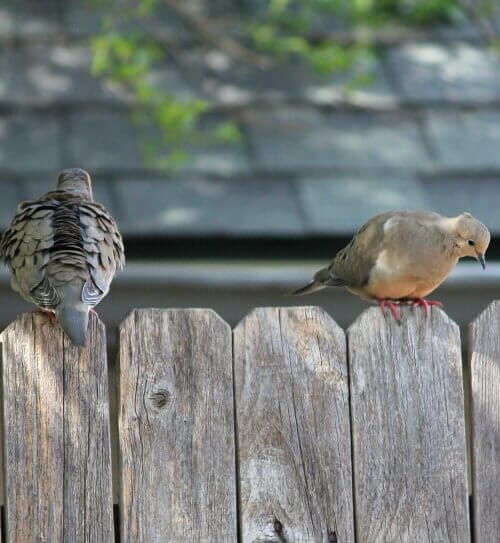
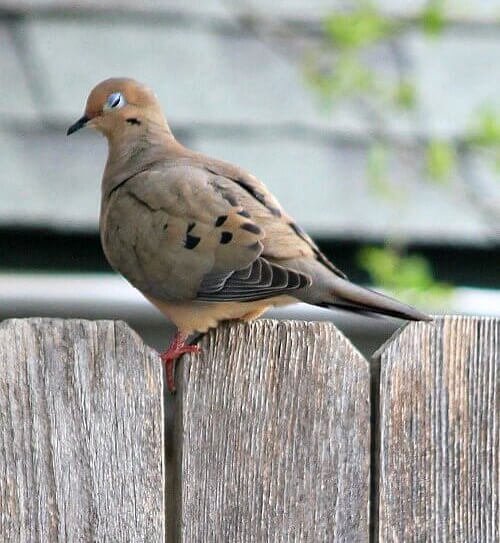
I love to watch these birds. In some ways, they seem awkward. Yet there is something quite elegant about them.
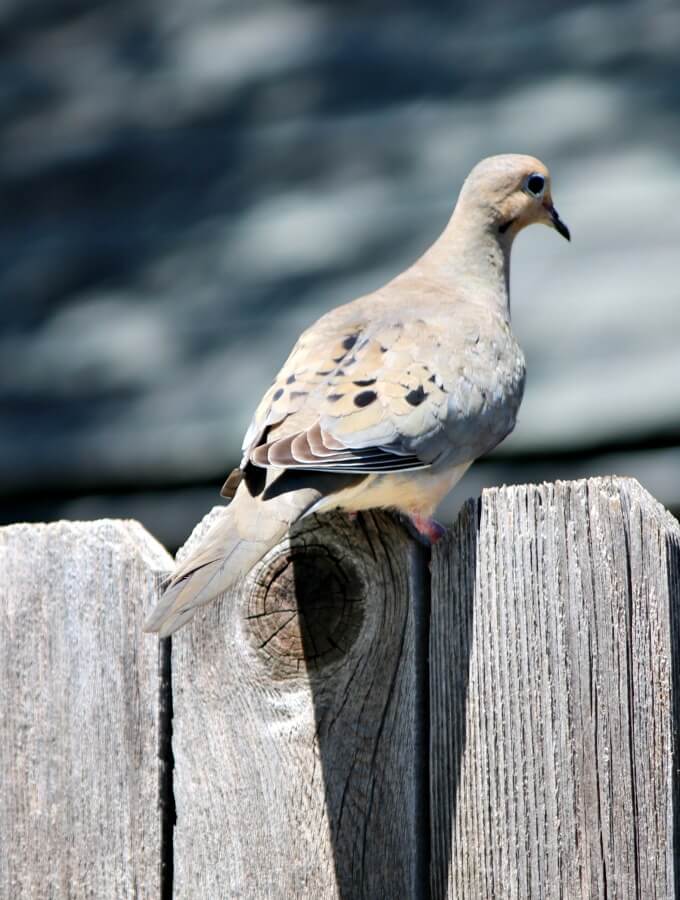
“A mourning dove’s beauty is an understated one. The color of its feathers range through various shades of gray and drab violet, often with a striking splash of turquoise around the eyes.” – Jonathan Miles
Mourning Dove Perching Habit:
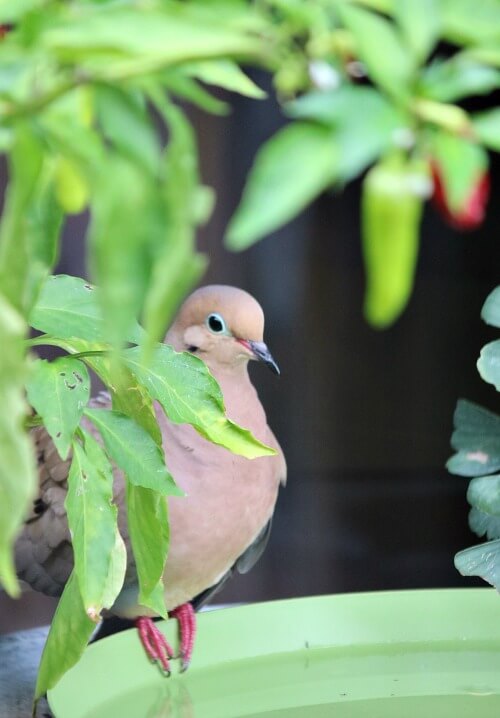
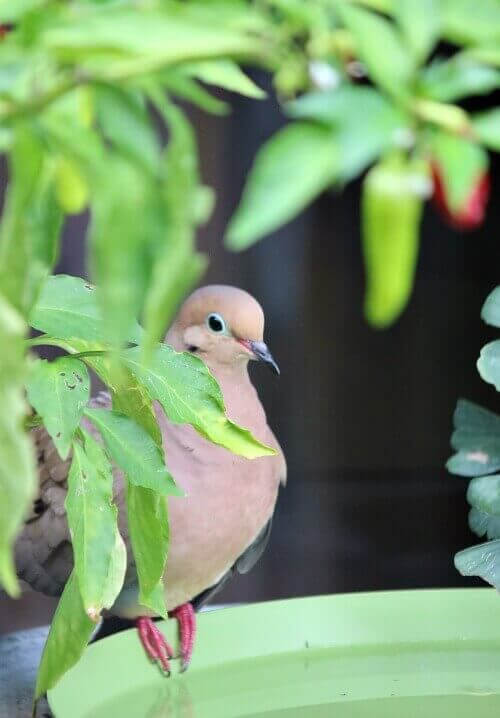
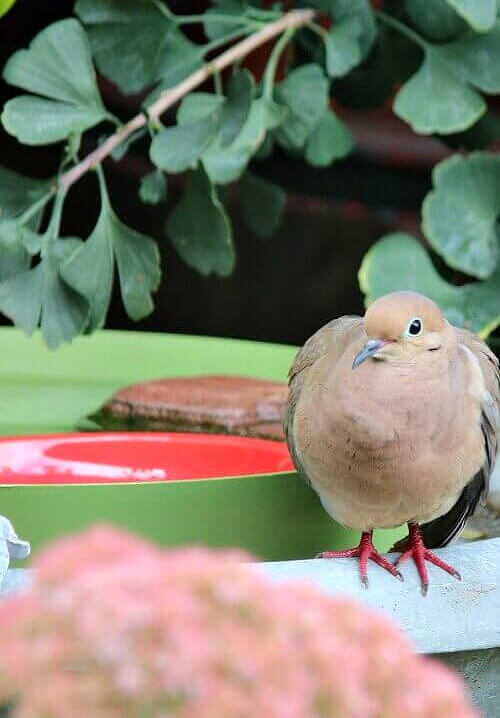
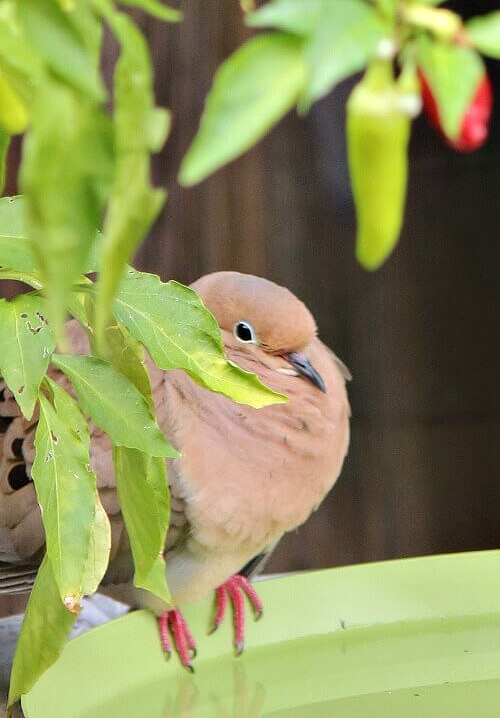
Today, the mourning dove found a place to perch among the tall stalks of the pepper plant and the Sedum Autumn Joy plant on my patio.
I looked out the patio doors from time to time, and these mourning doves stayed there for at least an hour. Most birds would have flown off long before that.
If you want to recognize their gender, the males have a bluish tint to their heads and a pinkish chest.
Females have a duller pink bosom and a light brown tint on their heads. Juveniles, on the other hand, are dark brown and puffy in appearance.
How Mourning Doves Drink Water:
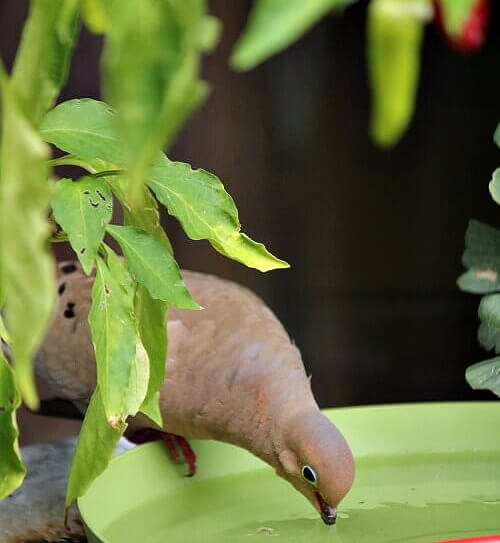
If you provide water for your backyard birds, you may have noticed that they collect only a small amount in their bills. Then they tip their heads back to swallow.
This is not the case with the mourning dove. Mourning doves drink by dipping their bills into the water and sucking up the liquid.
As a rule, doves require more water than other birds. This ability to sip allows them to drink more water while also keeping an eye out for predators.
When the mourning doves sleep, their heads rest between their shoulders close to their bodies. They do not tuck their heads under their shoulder feathers, as many other birds do.
The habits of the mourning dove reflect simplicity, peace, and resilience. From their distinctive cooing to their faithful nesting behavior, they remind us of the beauty of everyday wildlife.
Whether you’re a bird enthusiast or simply someone who enjoys their calming song, mourning doves are a true treasure in the natural world.
A few random sticks; the nest of a mourning dove. As fragile as peace. – Wayne Sapp



I have a dove nest in the crotch of my orange tree. Also have some fine Lettuce and chard growing on my walled patio. Also have small wall fountain. Only issue with doves is they drink from fountain, then turn around and poop in the fountain.. I have a small net I use, but sometimes it’s really hard to get their droppings out.
After birds leave nest will they be staying on my patio for some time?
Great pictures.
My Doves have been nesting on my patio for 2 years now. they are working on 5 set of twins. If I’m reading some of these e-mail it sounds like this could go on for years. They are in my flower box, I talk to them, they let me get with in 3 to 4 ft of them, plant flowers, water. So how can I move them, any ideas
I was wondering if they sleep in a nest type cover or just out on a branch.
I live in Mesquite Nv, and enjoy the day watching the mourning doves 8n my back yard. We have lived here for 14 years and this year I watched the mother and father deal with 3 . The babies would show up around 5:00 AM. Daily in my back yard. All day they would sit under some bushes that are in the yard while mom or dad stood guard from above. They would leave at dusk. Most of the time they would be pecking at the ground. Very disciplend they would stay in about a 5 foot area, if they tried to leave mom or dad would soop down and send them back. I just love to watch them in their daily activities Such peaceful and pretty birds. We are very lucky I know they will be with us for a long time.
Lovely! I have watched doves in my backyard for years. I learned so much from your article!
Loved that you shared the details of a dove, so sweet and peaceful. Imagine its cooing, as I read your post.
Great pictures of the dove, they are such lovely birds, I love to see them in the garden.
As fragile as peace. How beautiful. We have lots of mourning doves in Austin. Thry have a lovely cooing call. Great read!
There was a spruce tree in our front yard when we moved here about 40 years ago. For all of those years the Dove family built nests and raised babies there. Usually the nest was in almost the same place in the tree branches each year. It was always just so few twigs that you could see daylight through the twig nest. The nest was always right outside our front door, at eye level by the time we had come up the steps and inside our home. For the first few years I fretted about their nest and the eggs or babies in it every time the spring storms came, but the little doves always survived the storms and grew up to build in close neighbors’ evergreen trees, or in our spruce, but they always had their family reunions as they grazed around in our front yard eating various seeds and taking turns at the birdbath. Generations of what I believe must have been the same dove family maybe have always lived here, before we did, while we are here, and I suppose after we are gone from here. Our spruce tree had to be cut down almost two years ago, so their old Homeplace is gone now, but the generations still return to graze in our yard and drink from the same old birdbath. I’ve been wanting to plant another spruce tree,
I always think of my grandpa when I hear a Mourning Dove because that is the first time I ever heard one when I was at my grandpa’s house. So mournful, yet a beautiful sound. I think of them as gentle birds, but we have one who will come and sit in the middle of the feeder box and very aggressively chase all other Mourning Doves away. Thank you for all the information about one of my favorite birds.
We have several Mourning Doves in our yard. I love their gently coos. I never knew how to tell male from female though. Interesting…now I can name them! 😉
Just a quick note Brenda our lil Mallory survived her surgery but it has been an ordeal she came home with 50 + stitches and drains .This has been more of a surgery than we were told before ,she seems better today ,thank you for your concern .It is going to be a huge recovery process .
I love the morning doves ,they are quiet elegant !
Glad you have them to keep you and Charlie company .
And very Glad Charlie is doing so good .
Hi Brenda, I hope you are doing well! We had a nest with mourning doves on our porch this year. Two little babies only, one fell out of the nest and onto our porch. We moved some hay on the porch under the nest area in case the other one fell out. And you are so right on the flimsy nest…didn’t look like much of anything would stay in it! I’m working on getting back to the blog…look forward to reading your posts again!
I saw that you had posted, but haven’t gotten around to seeing it. I subscribe to your blog.
I know you are busy and thank you!! I’m just glad to finally be able to catch up and start writing again!
Benita, I read that the Doves eggshells are harder so the male takes the eggs and drops them to crack them. Amazing if true! But how far would be safe and how does the baby get back into the nest? I’m loving watching my little crew and learning about them!
I am in NY. We had two doves that came back every year for about 4 years to a nest they remembered in a barn that was really more like a lean to. Finally last fall my husband put walls around it to use for storage and no access to the nest when they would return. Tough decision but it was needed. It broke my heart in spring when I saw one trying to bang up against the building trying to get in. I cried and my husband tried putting a large wooden box up in a nearby tree to give them shelter and build a new nest. It didn’t work. I tried feeders near by. Didn’t work. Gone, moved on. We felt terrible and once again only people with hearts for animals would know how we anguished over it.
I would have been upset watching that too. Sorry this happened. From what I found out, they like to build flimsy nests. Do you have a bird bath? That seems to be what brings birds to my patio as I don’t have food out.