

The Single Woman’s Guide To Stretching Dollars
This post may contain affiliate links. If you purchase through links on my site, I may earn a commission at no cost to you. For more information, please see my disclosure policy.
I have tips for the single woman’s guide to stretching dollars. It’s not easy getting by on one paycheck.
There are so many expenses eating away at our bank account—housing, utilities, food, insurance, etc.

I think we all struggle with finances and lie awake at night trying to figure out how to stretch our limited dollars.
Where will the money come from?
We try every way we can think of to make food go farther. To save and put money in the bank. Often, we just try to figure out how to make it through the month.

Create A Budget:
Many of us are retired and on a fixed income. Others are self-employed, and their monthly income varies. I am both.
So how on earth do we keep up with inflation and constantly rising costs these days?
First, sit down with all your monthly bills and create a budget. Housing is most often our most significant expense, unless you’ve already paid for your home. If you have, you’re already way ahead of the game.
Or if you rent, one popular guideline is the 30% rent rule, which says to spend around 30% of your gross income on rent. So if you earn $3,200 per month before taxes, you could spend about $960 per month on rent.
Expenses:
You’ll need to pay for rental insurance, home insurance, medical insurance, or Medicare. And if you own or lease a car, you’ll have that expense plus the cost of car insurance.
From there, jot down your utilities, any other expenses, and then groceries.
At the end of your budget, include items such as entertainment and/or eating out. Things that aren’t necessities but that you enjoy doing.
Monthly expenses for a single person can vary, but the average is about $3,405. The average annual spending on housing is $ 1,885 per person per month. Transportation costs come to around $914 per month. Food expenses can range from $300 to $540 per month.

An average electricity bill is over $100 per month, though it varies.
The Single Woman’s Guide To Rental Expenses:
I currently rent an apartment. When I was looking to move, it took me a long time to find a place to live that was in a safe (or somewhat safe) neighborhood.
But the biggest calculation I had to make was cost. Rent is not cheap. Houses that had 1000 square feet or less were unfortunately out of my price range. So are most duplexes.
Rental properties in urban areas often require monthly parking fees. You will have to pay a pet deposit if you have a pet. And you’ll often pay a monthly fee per pet.
I don’t mind living small. In fact, I welcome it. Less square footage means less money you have to spend on maintenance, utility bills, etc. It’s less to clean and maintain.
All of those expenditures take a big bite out of my income.
Buying A Home:
I had considered buying a condo a few years ago. But at the time, I could see it wasn’t going to happen in a seller’s market. And I have no house equity for a down payment. I have saved as much as I can, and I think I could make a relatively decent down payment.
But now I’m revisiting that idea. My daughter, a realtor, recently suggested buying a condo again. So we are looking into that possibility.
If you are a single woman and looking to buy a home, there are programs designed to help you. My bank told me I will qualify for one of them based on my income, or lack thereof.
Programs To Help In Buying A Home:
- The USDA (US Department of Agriculture) housing program for single families
- Home-buying assistance from the federal government to help in purchasing a home
- Mortgage programs for single parents with low incomes
- Individual state programs for buying a home
Ask your bank about their community homeownership programs when shopping for a loan. There are also first-time homebuyer down payment programs that offer grants.
HUD’s Good Neighbor Next Door program helps firefighters, police officers, emergency medical technicians, and teachers qualify for mortgages.
There are first-time home buyer programs. Many lenders allow you to qualify if you haven’t owned a home in the last 3 years.

I receive a fixed monthly Social Security benefit. My side hustle is blogging, and I make a different amount every month. I never know how much I’ll be dealing with, and I have to worry about emergencies not included in the budget.
So I tried to see what I could cut back or eliminate.
Cars + Gasoline + Maintenance/Repairs:
Luckily, my Pathfinder is paid for. It has under 60,000 miles and is now 18 years old.
It has been a great vehicle with very little upkeep. And I mean significantly, very little upkeep. It has been a gem of a car. I can count on one hand what has gone wrong with it during all these years.
I buy premium gas for my car because that’s what the manual calls for. But I could not afford to do this if I drove around a lot.
Usually, I fill up my gas tank about once per month. And I always have half to three-quarters of a tank of gas still in the tank when I do fill it up again.
I chose to live in a neighborhood close to most of what I need. And I try to run more than one errand at a time when I do go out. I always try to take the shortest, most direct route that makes the most sense.
Picking Up A Takeout Meal:
I very rarely go into a restaurant to eat. More often, I will pick up take-out.
Sometimes I will work until I’m hungry, look up at the clock, and realize I’ve got to figure out a meal for dinner.
There is a Chinese restaurant whose food I love. I will go and pick up two tofu and vegetable entrees at lunchtime because meals are cheaper then. The meal also comes with an egg roll and soup.
By doing this, I have meals for two evenings without having to think about what to eat.
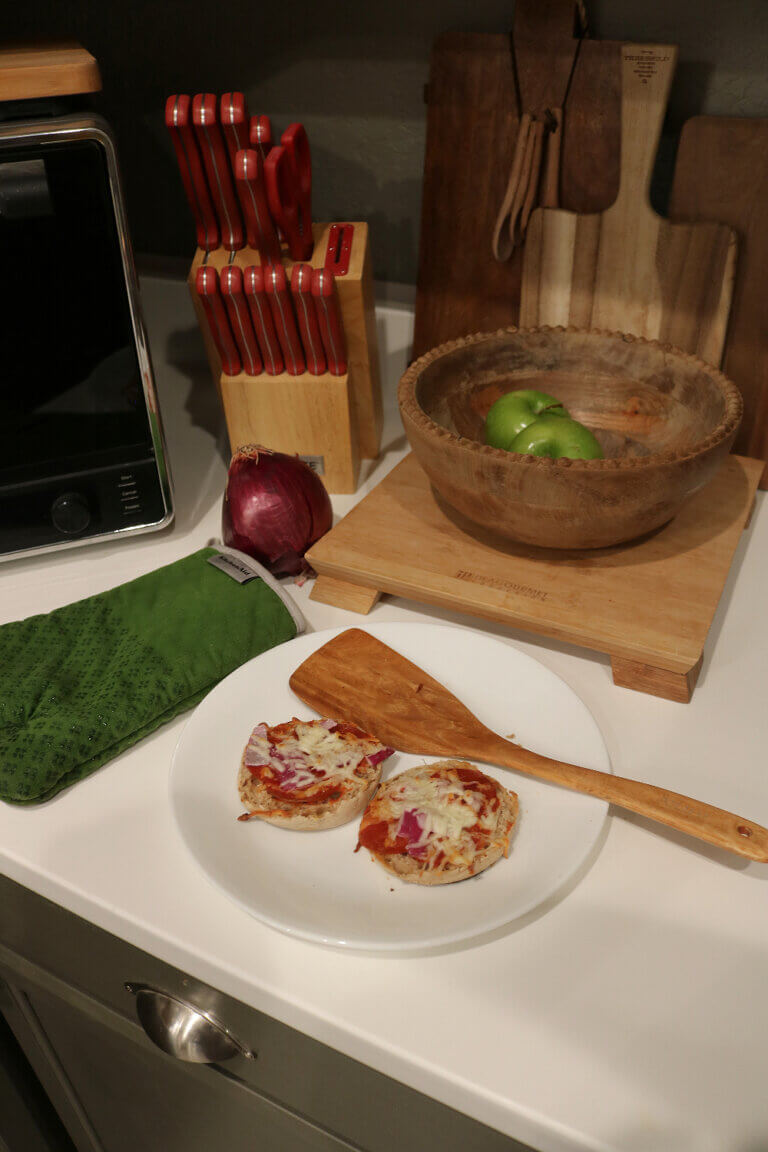
Then all I have to do is reheat the meal in my countertop convection oven at suppertime. In about 10 minutes, my meal will be ready to eat. It is a filling meal.

The Single Woman’s Guide To Cooking Meals
When I cook, I tend to make meals that stretch for more than one meal. Often, I make taco soup. I usually eat taco soup for several evenings, then I put individual portions into baggies and freeze them.
When I make casseroles, it is easy to make more than one meal. I can eat leftovers for several nights, then I freeze the rest. It’s usually best to freeze leftovers in individual portions to avoid waste.
Beans are cheap. I grew up eating beans pretty much every other day. A handful of beans packs a protein punch. If you eat a cup of beans, that averages at around 15 grams of protein, or 30 percent of the recommended daily amount.
Often, I scramble eggs and have them with toast for supper. It is filling, cheap, and quick to make. Or I might make a grilled cheese sandwich and open a can of soup.
The Single Woman’s Guide To Shopping For Groceries:
The outer edges of the grocery store are where fresh produce, dairy, meat, and fish are located. These foods are whole and unprocessed, making them among the healthiest choices available.
I now have my groceries delivered due to health problems. This makes it easier to buy what I actually need. I’m not seeing extra stuff at the store that I’m tempted to pick up.
I buy very little meat. If I do buy meat, I use it to make stews and casseroles that serve more than one meal. I’m just not a big meat-eater.
Most days, I make myself a smoothie to replace one meal. I don’t particularly like to eat lunch. So that is my usual substitute.
A single woman will find that store deals like “buy more, spend less” are a wasted proposition for her because extra food will go to waste. A single woman should buy only enough produce to last a few days.
The store deli is a single woman’s friend because you can order exactly what you need and no more.
Single women must learn to scale recipes for one person. Plus plan meals and recycle leftovers.

Other Food Tips:
I freeze sliced bread as soon as I get it.
When I want a sandwich, I take two slices out and put them on a plate to thaw. You’ll waste less bread this way, because freezing bread means it will keep longer.
When I order pizza, I individually wrap each leftover piece in aluminum foil and freeze it. Then, when I’m hungry for lunch, I take one or two pieces of frozen pizza out and cook them in the convection oven, which takes about 10 minutes.
I also buy store-brand frozen fruit to make smoothies. This helps to keep costs down, and frozen fruit lasts longer than fresh fruit.
Some fruits retain more nutrients when frozen, while others are better fresh. Nutrients in fruit are at their peak right after being picked. Because fruit is frozen quickly, it retains nutritional value.
Entertainment:
I don’t go to movies or concerts. I watch about an hour or so of streaming TV at night before I read a book. I order used books from ThriftBooks.
The cable bill was eliminated years ago. It was expensive, and I don’t watch enough TV to justify the price.
I currently subscribe to Netflix, Amazon Prime Video, and BritBox.
TV and books are my only form of entertainment, except for Ivy, my cat. She entertains me a lot!
Income:
More American women are single now than ever before. To live “comfortably” as a single person in 99 of the largest U.S. metro areas, you’ll need a median income of $93,933. This data is according to a recent SmartAsset analysis.
Comfortable is defined as the income needed to cover a 50/30/20 budget, which assumes 50% of your monthly income covers necessities. Necessities are housing and utility bills. Thirty percent covers discretionary spending, and 20 percent is set aside for savings or investments.
My blog is my business, and I’m constantly looking for ways to improve it. It is typically about half my monthly income. The other half is Social Security benefits.

These two forms of income are nowhere near the levels in the SmartAsset analysis. But I don’t live in one of the largest metro areas listed either.
Social Security:
Few people can get by with Social Security income alone.
Social Security cost-of-living adjustments, or COLA, increase benefits once per year and are usually less than 5%. Nearly 55% of Social Security beneficiaries are women.
Women face greater economic challenges in retirement. According to the Social Security Administration, this is because:
- Women tend to live longer than men
- Women often have lower lifetime earnings than men
- A woman may retire with smaller pensions and other assets than men
You might also want to read:
- The Single Woman’s Holiday Guide
- Single Woman Dining Alone
- A Girl Can Buy Herself A Valentine’s Bouquet





A few years late reading this article. One thing that is definitely frugal is making use of your local library. You can check out books or many libraries subscribe to digital formats for Kindles and other devices. They also have books on CD and DVDs to checkout often for free (my library charges a dollar to rent a movie for a week and does very well at getting recent movies and series from TV.) I have read of libraries that also checkout puzzles and games. I am fortunate in my retirement to work at our library. Often I will go to Barnes and Noble and find books I like, then go to work and see it they can order it. Most of the time they do!
Brenda, thanks for these tips! I’m always looking for ways to save money and cut spending. The property taxes here in Texas will break you, so you have to look for other ways to hold onto your $$$. Love and hugs!
When you add left over coffe to baked beans, they taste smokey. A little bacon provides fat that will satisfy your hunger longer.
What a wonderful post! Thank you everyone for all these wonderful tips, which are unfortunately extremely relevant to my life right now. In September my partner and I split up and all the expenses we had been splitting are now my sole responsibility.
Also in October, my two senior dogs who had been seriously ill for a few months passed away and I had a series health issue myself…all of which were wildly expensive. I have been on SSDI since 2015 and when I turned 62 it transitioned into regular SS which came with a Medicare part B payment. Needless to say, I have no money.
This is the embarrassing part.
Credit card debt. I just can’t make my payments. They are calling me all the time and the interest rates are pulling up. I am so stressed, grieving the loss of my babies, can’t sleep and don’t know how to fix anything. They refuse to accept $10 a month apiece and even paying that little would be a stretch. I hate not honoring my obligations. This time last year I had no debt but then car issues. Dogs. Hospital and medications. Life.
I would love to see this become a regular feature.
Any suggestions for the debt – ridden?
File bankruptcy. It will be on your record for quite a few years. But I had to do it in about 2013 after I got divorced. Within a short time I was being offered credit cards. My accountant told me to get some and buy stuff and simply pay it off fast. Now my credit is very good and I never get turned down. That’s how I did it because my ex was so materialistic he ruined my credit. My credit is not in the 700s.
And I’m so terribly sorry that you lost your babies. My heart is with you.
Thank you, Brenda! I thought of bankruptcy but I know it’s expensive and I am broke. It’s nice to know that you can come back from bankruptcy. You should be so proud of how you’ve rebuilt your life.
I keep you and (of course) Abi Rose in my heart too.