
Fun Facts About Cardinals
This post may contain affiliate links. If you purchase through links on my site, I may earn a commission at no cost to you. For more information, please see my disclosure policy.
I want to share some fun facts about cardinals with you. Cardinal couples are one of my favorite birds to watch on my patio.
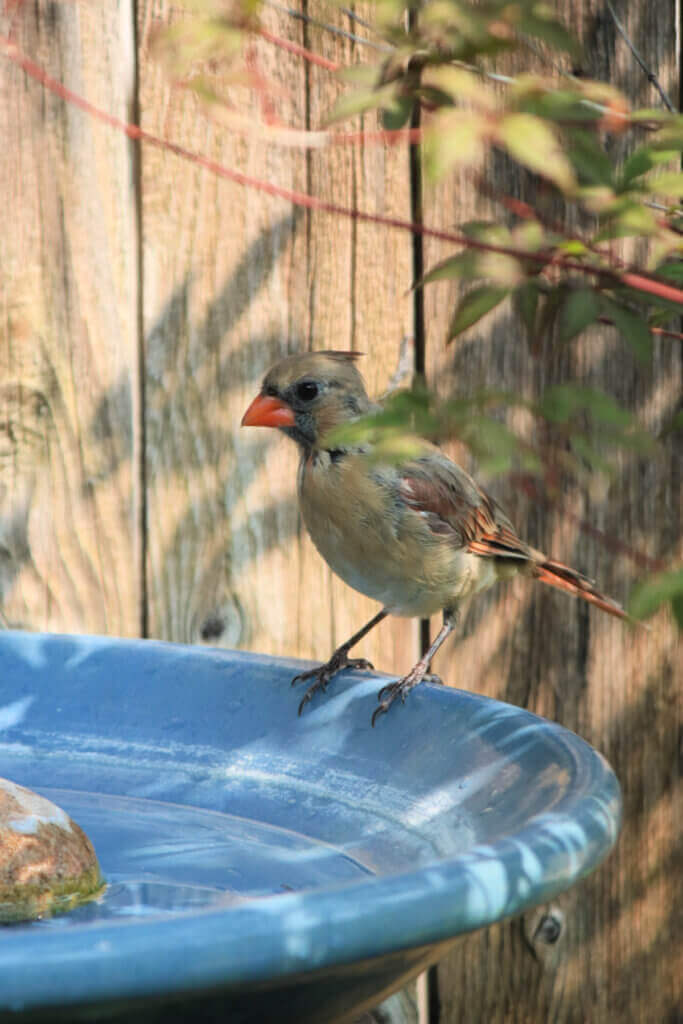
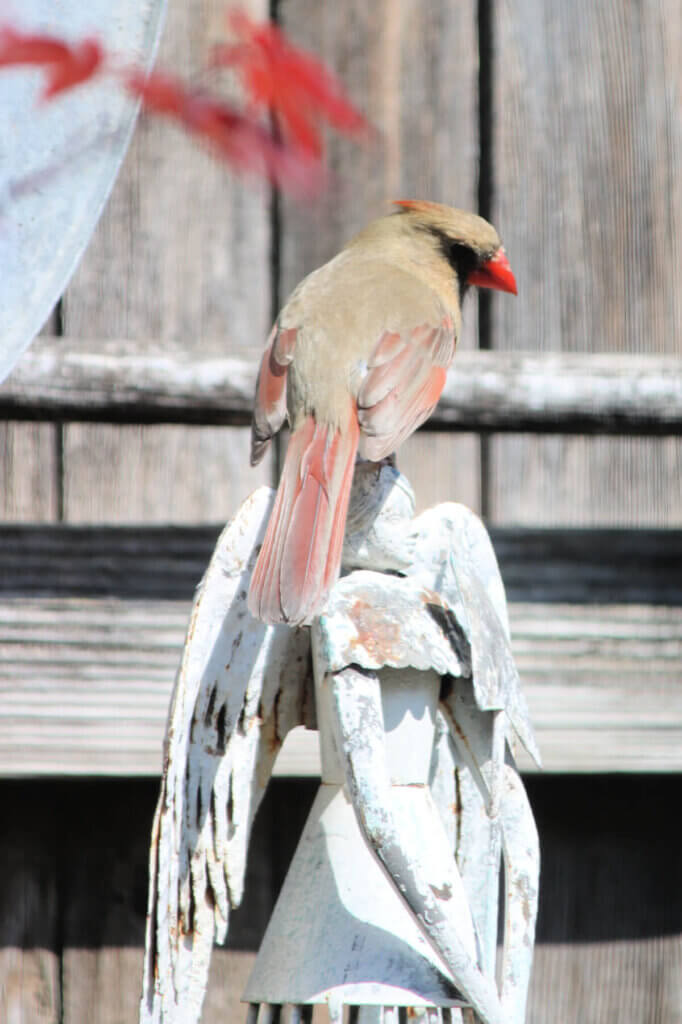
The female cardinal came around to the patio yesterday, but her mate was not in sight. Trouble in paradise? Oh, I think not.
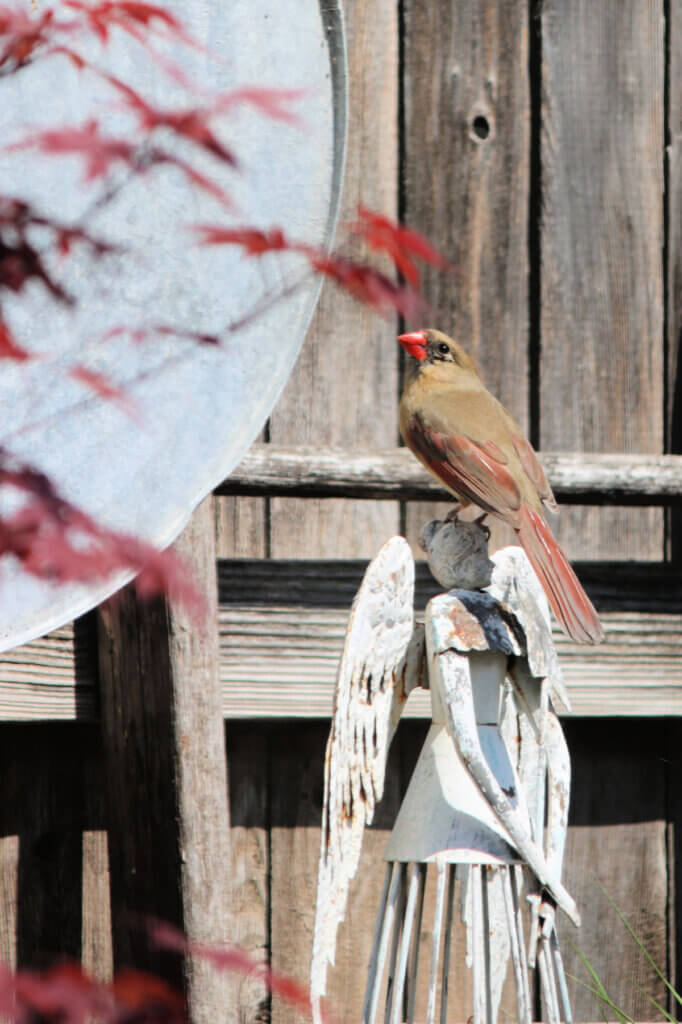
Even with her light-colored feathers, she is attractive and blends into the background. I suppose this is the whole point of her having light plumage.

The male is easily spotted with his bright red feathers as he perches on the bird bath.
Males & Females Have Different Colored Beaks:
Have you noticed another distinction between male and female cardinals? Another fun fact about cardinals is that their beaks are also different colors. Males have red beaks and females have orange beaks.
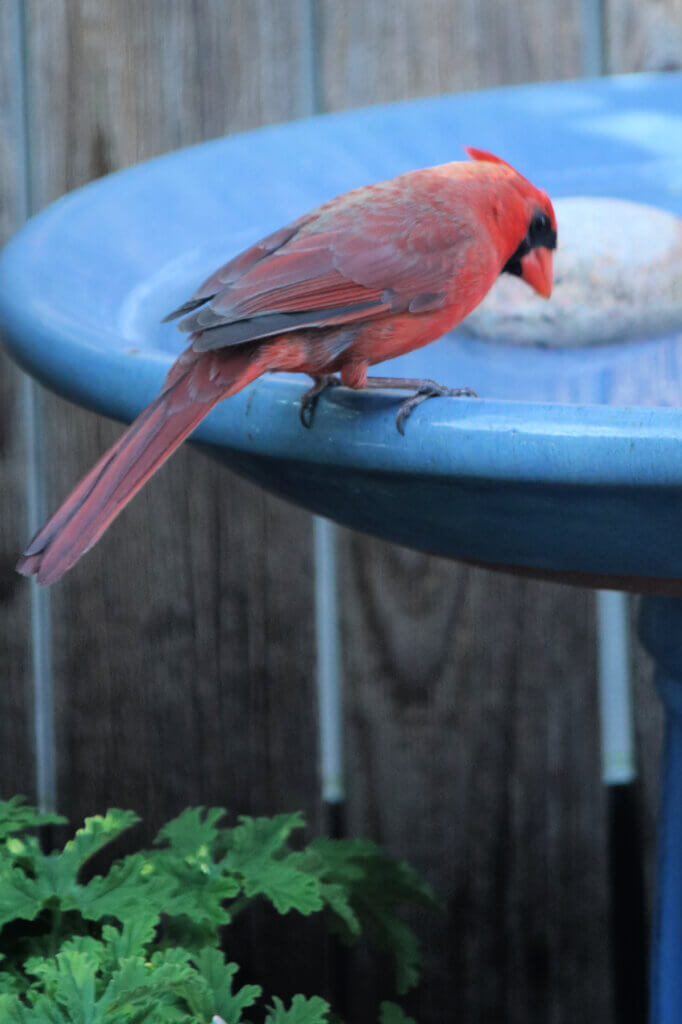
The red coloration that males develop in their plumage results from carotenoids in their feather structure. And they ingest those carotenoids in their diet.
That’s another interesting little fact about cardinals.
Vibrant yellow northern cardinals, which have a genetic plumage variation called xanthochroism, may be seen on rare occasions. I’d love to see one of these birds.
What Do Cardinals Eat?
Cardinals love to eat seeds, fruit, buds, and insects.

Cardinals are also non-migratory birds. They prefer to live within a mile of where they were born.
They are attracted to nesting shelves and cardinal feeders, especially those with a plentiful food supply.
Where Did They Get Their Name?
The fact that cardinals were named after the Catholic Bishops is another fun fact about cardinals.
One notable fact about the northern cardinal is that the bird was named for its color, which resembles the red robes worn by Roman Catholic Cardinals.
Cardinals Voluntarily Cover Themselves With Ants:
One of the most interesting facts about cardinals is that they practice “anting.” Over 200 bird species, including the Baltimore Oriole and the wild turkey, also cover themselves with ants.
It is possible that, because ants release formic acid, cardinals help themselves ward off lice.
The ants come from two subfamilies; they produce defensive secretions to repel attackers and don’t sting.

The cardinal holds an ant in its beak, spreads its wings, and lowers them. Then, it brings its tail forward between its legs, wiping the outer wing and tail feathers with the ant.
Cardinals also represent balance, symbolizing a powerful family unit. The father cardinal is responsible for nurturing young birds.
Parent cardinals lead well-balanced family lives, allowing both parents to take care of and nurture their children.
Cardinals Mate For Life:
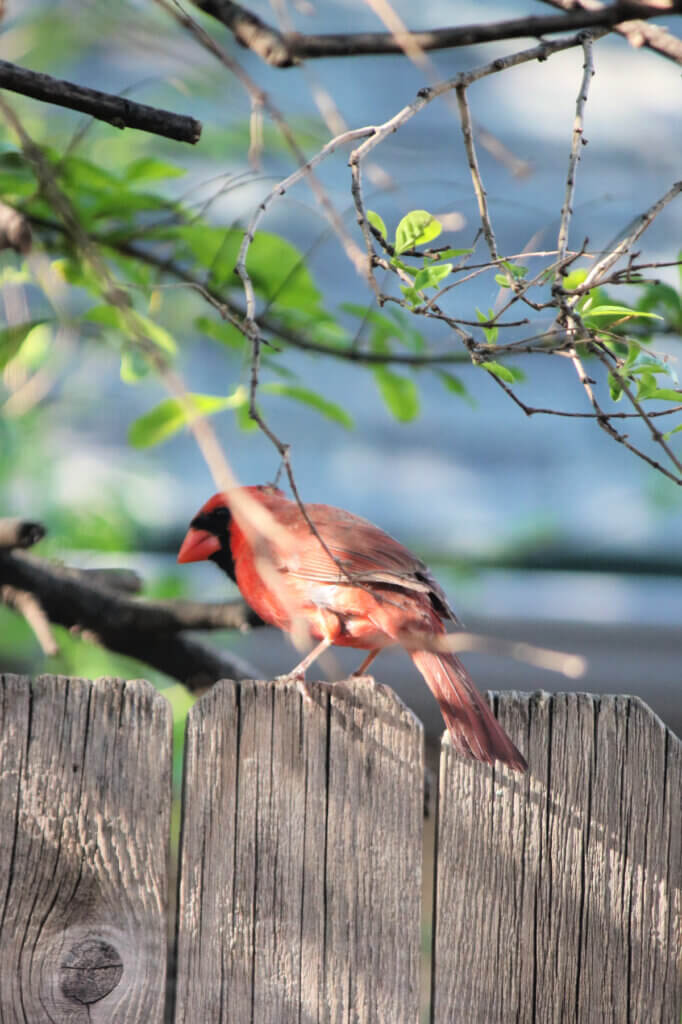
Another interesting tidbit about cardinals is that they are monogamous birds.
After a male cardinal bird has chosen a female, the two will begin building a nest.
They will use various materials, such as leaves, grasses, tree bark, and small twigs, that they gather and weave together.

You will typically see a cardinal nest lined with animal hair and soft grass. Female cardinals lay 3 to 4 eggs, which are incubated for 12 to 13 days. The male occasionally helps with incubation.
The survivor quickly looks for a new mate if one member of the pair dies.
Female Cardinals Sing To Tell Males When They Need Food:
Cardinal sounds vary between males and females. The male typically sings to attract mates or ward off intruders. The female typically sings to signal the male to bring food to the nestlings.
The cardinal’s male call is an aggressive song used to defend its breeding and nesting grounds. Females will sing more elaborate songs.
The cardinal is the most popular state bird in the United States. Seven states have the Northern Cardinal as their state bird: Illinois, Indiana, Kentucky, North Carolina, Ohio, West Virginia, and Virginia.

Ivy Watching Birds:
And oh, does Ivy love to watch the birds. She will stare out the window at them. When she sees one cavorting around the patio, she will thump her tail in indignation.





I’ve learned that there are lots of things about cardinals I didn’t know! Can’t seem to visualize “anting.” I’d love to see a yellow cardinal!
I cannot visualize a Cardinal anting itself without thinking that it must look like it’s applying deodorant.
Brenda, I love cardinals but I have to be honest, I don’t think I knew very many of these facts, especially the anting. I’ve never heard of anting.
Thank you for so much for giving us the information about the Cardinals. They are my favorite bird and also my mother loved them too! As Kris said, whenever I see a cardinal I feel my mother’s presence and it gives me so much comfort!
I have a big smile on my face right now. I loved reading about the birds and all the interesting facts but when I got to the end I laughed out loud when the pic of Ivy showed up. Of course, she likes the birds. Great blog and hugs to Ivy!
I love cardinals and I had no idea about that ant thing. Laura
Florida’s state’s bird is a mosquito!
Hi Brenda 🌼
Loved your post on cardinals!
A good learning experience 👌
They are simply gorgeous birds. Coloring in each is just so beautiful. ❤ We have them in Illinois. My youngest sister longs to hear the male cardinal sing, come into our yard. They are very musical. 🎵 🎶 Great post!! Thanks for sharing! ❤
Cardinals are my favorite birds. They are gorgeous and I did not know all these facts so thanks for sharing. I also believe that when a cardinal is near so is a love one that has passed on. Since my mom died I occasionally see a female cardinal and I feel it is my mom’s way of saying she is near. Have a great rest of the week.